
When I think about effective leadership, my experience tells me this is when you see deliberate and active leadership that intentionally looks to ‘Lead Through Others’.
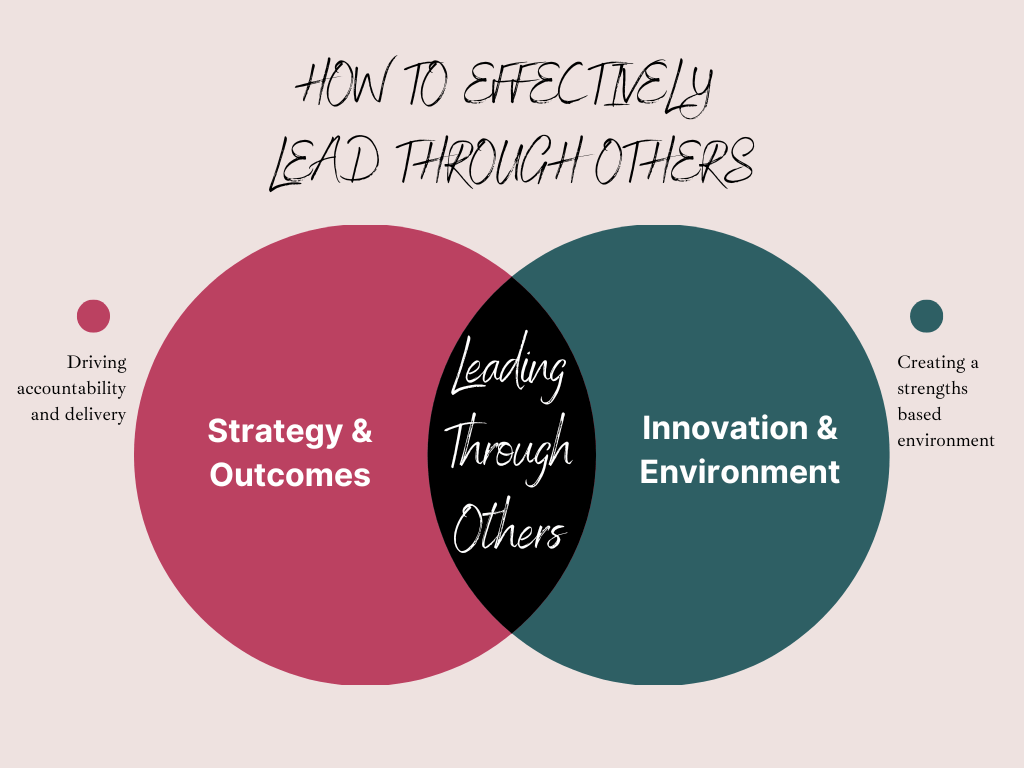
Most leaders or managers lean into one of two ‘camps’:
1. a focus on ACCOUNTABILITY
This dedication and focus often sees leaders with their hands in at every level and a level of focus on delivery that feels a lot like mistrust.
While accountability is key for leaders, fostering this in a way that encourages lifting up to the strategy and outcomes level can make the difference between micromanagement and strategic, outcomes-focused leadership.
2. a focus on ENVIRONMENT
While focusing on the team environment and culture is well intentioned, prioritising how the team environment feels and is received, this alone cannot drive performance and innovation.
Managers who are only about the team often miss the big picture necessities of leadership and see the prioritisation of delivery an added bonus.
I know that if you are to truly ‘Lead Through Others’ then it is a combination and connection between these two approaches that creates excellence, drives innovation, and staff are connected and excited about the purpose of the organisation.
In today’s MR Musings, I am going to explore some of the key elements (or competencies) that I view as important when considering Strategy and Outcomes.

Leaders need to be able to think long term and strategically, which sometimes requires stepping back from day-to-day operations.
Strategic thinking is a critical competency for leadership and accountability.
Without it you are less likely and able to anticipate challenges, identify opportunities, and adapt as required.
But add this to your leadership toolkit and you are looking at ways to align the vision of the organisation with action and foster innovation that drives growth and a competitive advantage.
Having the ability to anticipate, plan and execute with a long-term perspective is important. Doing this while addressing immediate challenges lifts this competency to the strategic thinking level.
- Develop vision: craft clear, actionable strategies aligned with organisational goals
- Enhance decision making: use data and analysis to make informed, forward-looking decisions
- Inspire teams: articulate a compelling vision that unites and motivate teams toward shared objectives.
Strategic Thinking is an essential competency for sustainable success.

As a leader, having the ability to define, communicate and execute a clear and inspiring direction for your people is like gold.
In a world where purpose-driven work is increasingly valued by staff, being able to communicate and connect the organisation and team vision and goals in a meaningful way cannot be underestimated.
The vision and goals are not a once and done development and communication exercise. They are the expression of the organisation’s aspirations for the future and a catalyst to inspire collective action.
Having clear and well communicated vision and goals is essential for leader to be successful as it provides direction, motivation and alignment for your people.

Effective delivery outcomes and objectives emphasis lies in achieving results through good planning, delegation and accountability.
Delivery Outcomes
The outcomes of the organisation translates the organisations goals and plans into tangible results. Critically, outcomes can only be achieved through effective delivery of the objectives, supported by fostering collaboration, monitoring performance and adapting to challenges.
Outcomes ensure accountability, inspire teams and drive continuous improvement to meet or exceed expectations.
They are closely aligned to the vision and goals of the organisation.
Delivery Objectives
This is where leaders define clear goals that align with the organisational strategy, ensuring that tasks are prioritised and resources are allocated efficiently.
This involves setting measurable milestones and aligning team efforts toward the shared objectives.
Often, it is the leader’s role to describe how actions and objectives collectively sum to give effect to delivery outcomes.
Think – a collection of like objectives sum together to support an outcome.

Effective communication is a key tool for any manager or leader.
Knowing how to communicate, with who and when can make or break when it comes to change, delivery or general connectedness across a team or organisation.
Whether you are undertaking a large change programme or initiative, or are new to a leadership role, you can never underestimate the need to proactive and meaningful communication.
In every case, transparency is key.
We all know that without enough information team members will happily fill in the gaps with whatever story that fits their narrative.
It is also true that with too much spamming of communication that means very little to individuals, our people can tune out and then miss important updates.
Through my years of change and delivery experience, the key here is consistency. Much as it is true for showing up here on LinkedIn, it is just as true with communicating effectively.
There are a range of tips and tricks that you can apply to assist you with communicating effectively. My must haves are:
- Transparency – making sure you provide both the good and not so good information. Sharing this up, down, across in a way that ensure the ‘why’ is aligned.
- Consistency – from the key messages being repeated in varying forms to the regularity, consistency provides a natural cadence that helps to build trust and further foster relationships and connections.
- Clarity – simple plain language for key points. This is about ensuring there is no room for misunderstanding what has been said.
- Feedback loops – ensuring your people can provide feedback and comment, seek further clarification and let you know if how you are communicating is hitting the mark for them is key. Communication at its core is a two-way event – a conversation to be had.

Good leaders know how to effectively plan, setting clear objectives and devising actionable and realistic steps to achieve these objectives.
Great leaders do the above AND work to anticipate potential roadblocks, creating opportunities to get ahead and innovate early.
Clear accountability is more than checking off what needs to be delivered.
When you are clear on accountability, you foster trust, provide clarity and enable high performance within teams.
Accountability as leaders is about taking ownership of their actions and decisions, creating a culture of transparency and integrity. This often inspires team members to emulate behaviours, promoting responsibility and collaboration.
Clear accountability also ensures clear expectations, minimises ambiguity and can support the driving of innovation.
Decision making is easier, you have the ability to build organisational resilience and align your teams work and actions with the organisational goals.
I know that there are many contributing factors to successfully designing and delivering your strategy and outcomes within an accountability driven environment.
Driving accountability and delivery is a key component of successful organisations.
Let’s be honest, without it, you can’t demonstrate your worth, are unlikely to secure ongoing work and funding.
But there are ways in which you can deliver on what you say you will, and what you are expected to, while fostering a work environment that values your people and promotes innovation.
Over the coming MR Musings I will delve into other aspects of my “Leading Through Others” framework and how these can be effectively applied to shift and transform your leadership.

✔️Connect with me on LinkedIn. I provide regular posts and a fortnightly newsletter on my musings about life, work and what is generally on top.
✔️Sign up to my fortnightly newsletter MR Musings.
✔️Check out more about the services and programmes I deliver here.
These include:
- ‘Lead Through Others’ Coaching
- EXCEL programme
- LEADERship Foundation Programme
- Research and Advisory Services
- Change Leadership and Management
- Other Coaching and Support Resources.
✔️Let’s catch up and connect over a zoom coffee. Book a time to connect.
✔️Or contact me either through my website or via email.
Leave a Reply