
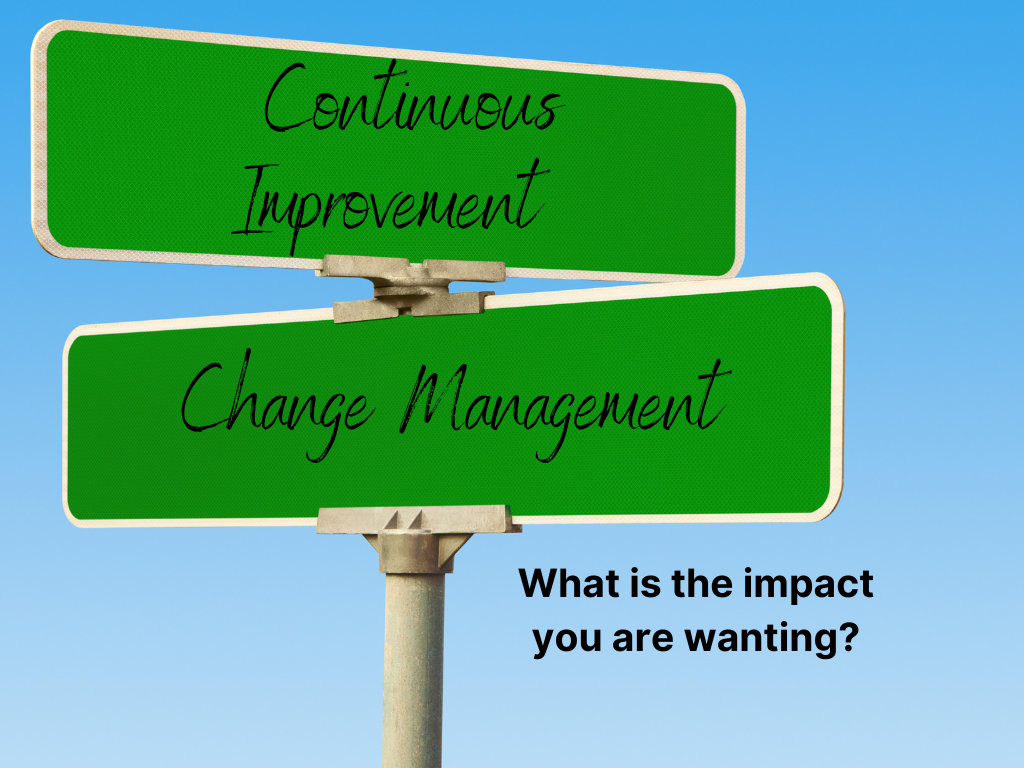
When you think about change are you considering the right or intended impact?
While I have worked as a change manager, had change incorporated into roles, what I have learned over years of delivery experience is that continuous improvement and building an environment that enables this works so much better in reality.
Yes, you will still have those larger or strategic ‘one-off’ priorities that require change management. But, with continuous improvement embedding in how things are done, the change will likely be more successful.
One way to think about this, and to check that you are considering the right change intervention, think of these two things:
- Continuous improvement is about cultivating a growth ecosystem
- Change management is about executing a single transformative event.
These definitions help to highlight the complementary but distinct advantages of continuous improvement’s ongoing adaptability and change management’s structured, episodic transformations.
So, for a little more detail, outlining the benefits of each, here goes:
Continuous Improvement as a Growth Ecosystem
- Sustained Evolution: Continuous improvement (CI) operates like a living ecosystem, where small, incremental changes accumulate over time, fostering resilience and adaptability. It ensures that processes, products, and people are constantly evolving in response to internal and external shifts.
- Cultural Transformation: CI embeds a mindset of perpetual learning and innovation into the organisation’s DNA. Your people are empowered to identify inefficiencies, experiment with solutions, and contribute to ongoing progress, creating a culture that thrives on collaboration and creativity.
- Employee Engagement and Morale: By involving your people in everyday improvements, CI fosters ownership, motivation, and pride in their work. This contrasts with the potential disruption or resistance that can accompany large-scale change initiatives.
- Agility and Competitive Edge: CI enables organisations to adapt incrementally to market dynamics, staying competitive without the abrupt disruptions often associated with episodic change management.
Change Management as a Transformative Event
- Strategic Overhaul: Change management (CM) focuses on managing significant transformations—such as implementing new technologies or restructuring—that require a structured approach to ensure alignment with strategic goals.
- Top-Down Leadership: It often relies on leadership-driven initiatives to guide the organisation through transitions, ensuring that large-scale changes are planned, communicated, and executed effectively.
- Focused Outcomes: CM is ideal for addressing specific challenges or achieving targeted outcomes within a defined timeframe. However, it may not inherently foster an ongoing culture of improvement.
The Synergy Between Continuous Improvement and Change Management – When combined effectively, continuous improvement sustains the benefits of change management by refining and optimising implemented changes over time.
While change management provides the initial push for transformation, continuous improvement ensures that improvements are maintained, enhanced, and adapted in response to feedback and evolving needs.
Together, they create an organisational environment that balances stability with innovation.
Continuous improvement is not just about efficiency but about embedding adaptability into an your culture—making it better equipped for long-term success than relying on one-off change alone.
Leave a Reply